I teach courses at Georgia Tech's Sam Nunn School of International Affairs and Daniel Guggenheim School of Aerospace Engineering on topics at the intersection of space technology and policy.
Space Policy
INTA 8803
As satellites orbit the Earth hundreds or thousands of kilometers above our heads, they quietly play a critical role in our daily lives, the global economy, and military power. To study space policy is to interrogate the decision-making processes for the civil, commercial, and military uses of outer space from the dawn of the space age to the modern day, spanning issues of international coordination, sustainability, and security in the domain. Through this course, students will learn about the diverse factors that have historically shaped space policy thinking, from the original rationales for spaceflight, to the birth of the commercial space industry, to the development of international systems that promote long-term stability in a rapidly densifying environment.
By engaging with the debates and decisions that have shaped global space activities, students will gain an appreciation for the role of space technologies in global society, the critical challenges facing this domain, and the intricate politics driving contemporary space policy in both the United States and around the world.

Download the Fall 2026 Space Policy syllabus here. 10 pages.
Spacecraft Flight Dynamics
AE 4532
Spaceflight is governed by a set of physical laws that dictate how satellites orbit, maneuver, and maintain their orientation beyond Earth’s atmosphere. This course introduces those laws in both theory and practice, providing a foundation in the principles of orbital and attitude dynamics that define spacecraft motion. Students will explore the forces that shape trajectories, and learn to design and analyze on-orbit maneuvers such as rendezvous, interception, and interplanetary transfers.
Building from orbital mechanics to spacecraft orientation, the course examines how vehicles sense, stabilize, and control their attitude in three dimensions. Students will work through analytical models and computational simulations to study rigid-body dynamics, stability, and control design. By connecting mathematical formulation to real mission contexts, this course offers a comprehensive view of how spacecraft navigate and operate across the near-Earth and deep space environments.
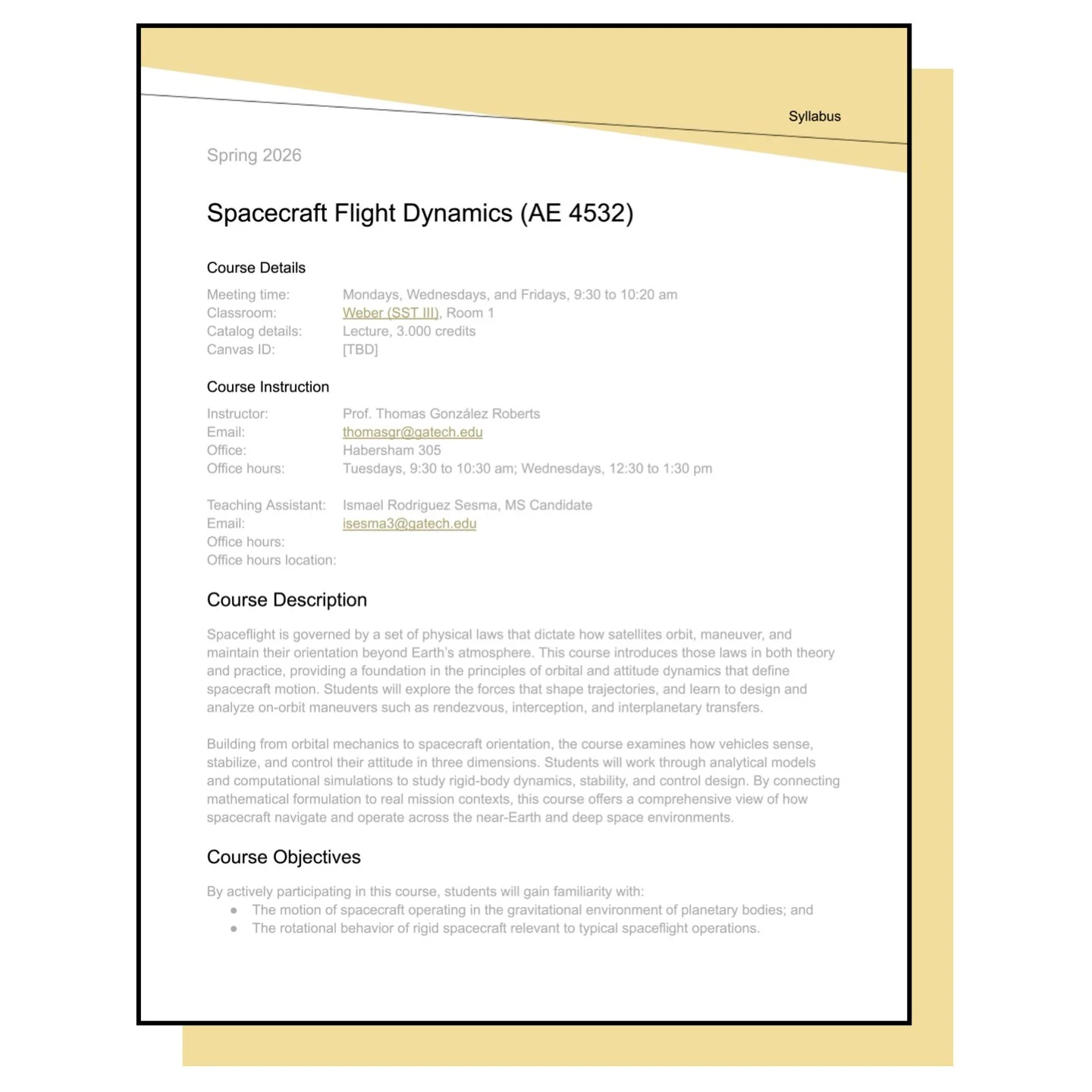
Download the Spring 2026 Spacecraft Flight Dynamics syllabus here. 10 pages.
Space Sustainability
INTA 4803
INTA 8803
Although the space environment is vast, the popularity of some orbital regimes—due to their usefulness for certain space missions—makes them more congested than others and subject to dangerous debris-generating collisions and harmful interference in the radio-frequency spectrum. In order to preserve the outer space environment as a safe, operational domain for the socioeconomic benefit of humanity both today and in the long term, space actors must adapt their practices to accommodate the expected growth of the space object population in the coming years. Through this course, students will study the factors that shape sustainable decision-making in outer space and earn familiarity with the data resources and analysis tools that form the foundation of evidence-based policy analysis on the subject.
As part of this course, students will propose and execute original research projects on orbital capacity. Students will use open-source astrodynamic software packages to model the future low-Earth orbital space environment under unique, but realistic combinations of policy and practice, and present their findings to subject matter experts.

Download the Spring 2026 Space Sustainability syllabus here. 10 pages.